


If you've spent any time shopping for proxies or troubleshooting bans, you've probably come across the word "subnet", often in phrases like "subnet diversity" or "avoid proxies from the same subnet." But what does it actually mean, and why should you care?
This article covers the core concepts you need to understand: what subnets are, how they affect proxy performance, what happens when you ignore them, and how to use subnet knowledge to build a smarter proxy setup.
What Is a Subnet?
A subnet, short for subnetwork, is a logical division of a larger IP address range. Think of it like a neighborhood inside a city. The city is the broader network; the neighborhood (subnet) is a smaller, grouped portion of it.
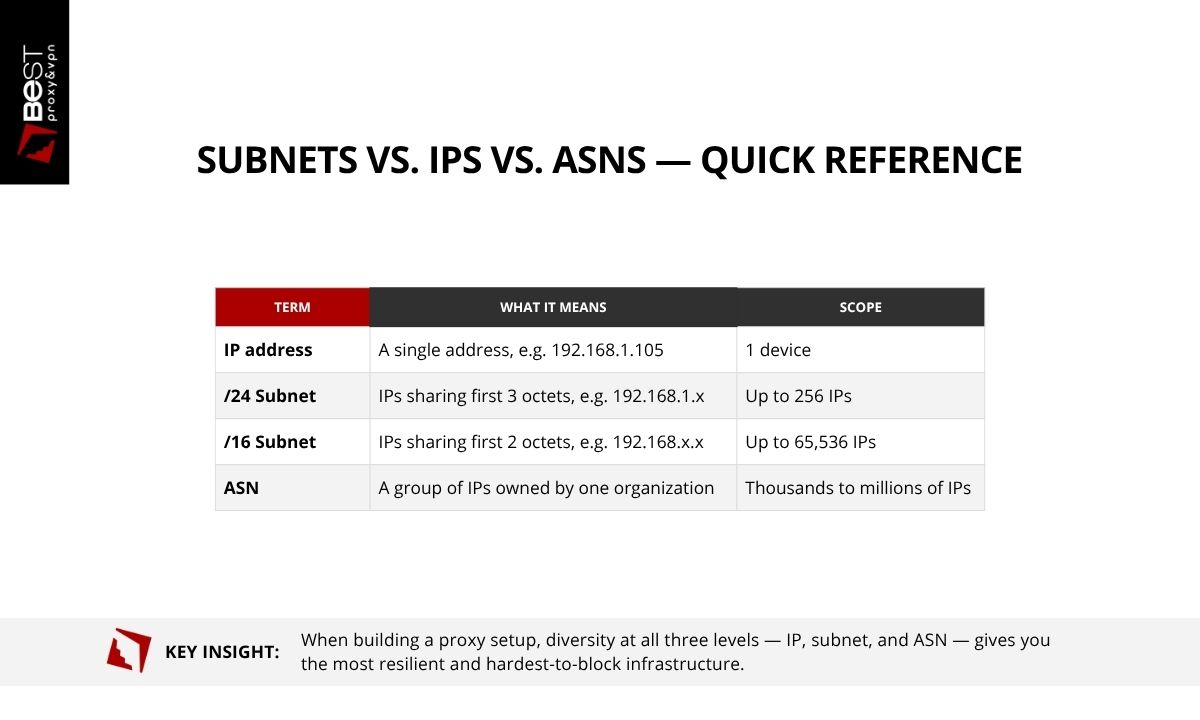
IP addresses are made up of four numbers separated by dots, like 192.168.1.105. Subnets are defined by how many of those numbers (or bits) are shared by a group of IPs. The most common subnet you'll encounter in the proxy world is the /24 subnet, which looks like this: 192.168.1.0/24
That /24 means the first three sections (192.168.1) are fixed, and the last section can range from 0 to 255, giving you up to 256 IP addresses that all share the same subnet. In plain terms: if you have proxies at 192.168.1.50 and 192.168.1.200, they're in the same /24 subnet. In practice, not all of those IPs are usable. A couple is reserved for network and broadcast purposes, but for proxy usage, the distinction usually doesn’t matter.
You'll also see /16 subnets (the first two sections fixed, ~65,000 possible IPs) and /8 subnets (only the first section fixed, extremely large address blocks that can span multiple organizations and regions).
Why Subnets Matter for Proxies
Here's the core issue: websites and platforms don't just look at individual IP addresses when deciding whether to block traffic. They look at patterns, and IP blocks are one of the most effective patterns to track.
If you're sending requests from 50 different IPs, but they're all in the same /24 subnet, a target site's bot detection system can block your entire subnet with a single rule. Suddenly, all 50 of your proxies stop working at once. This is called a subnet ban, and it's often more efficient than blocking individual IPs, especially for high-volume traffic, because it's far more efficient for the sites defending against scrapers.
In practice, subnet-based blocking isn’t just about hard bans. Many platforms use softer responses — throttling requests, increasing CAPTCHA frequency, or silently degrading results — before blocking outright. Subnet clustering often shows up there first.
What subnet diversity actually means
Subnet diversity means spreading your proxies across as many different subnets as possible, ideally different /24 blocks, and ideally different /16 blocks for highly sensitive targets.
For example:
❌ Low diversity: 50 proxies all from 192.168.1.x same /24 subnet
✅ High diversity: 50 proxies spread across 50 different /24 subnets
The second setup means a subnet ban on one block only takes out one proxy, not all of them. The goal isn’t randomness for its own sake. It’s reducing how easily your traffic can be grouped and flagged as a single source.
How Proxy Providers Handle Subnets
Not all proxy providers are equal when it comes to subnet diversity. Here's what you need to know when evaluating a provider:
Datacenter proxies subnet risk is real
Most datacenter proxies come from a limited number of commercial hosting providers (AWS, OVH, Hetzner, etc.). That means large chunks of their IP pool often sit within the same /16 or even /24 subnet. If the target site has previously blocked that datacenter's IP range, your proxies are dead on arrival.
That said, high-quality datacenter providers (like Bestproxyandvpn) can still offer strong subnet and ASN diversity. The issue isn’t the proxy type itself, but how the IP pool is structured.
Residential proxies subnet diversity is built in
Residential proxies use IPs assigned by real ISPs to real homes and devices. Because these IPs are spread across millions of households in different cities, regions, and ISPs, they’re typically spread across a wide range of subnets. This is a big part of why residential proxies are harder to block. It's not just that they look like real users, it's that they're genuinely spread across an enormous IP space.
However, the actual diversity depends heavily on the provider. Some networks recycle IP ranges or route traffic through a smaller set of exit nodes, which can reduce effective diversity.
Mobile proxies often the hardest to block at the network level
Mobile proxies use IPs from mobile carrier networks (4G/5G). Carriers use a technique called CGNAT (Carrier-Grade NAT) that routes thousands of real users through shared IPs, which means a single mobile IP could be used by hundreds of real people simultaneously. Blocking that IP would mean blocking legitimate users, so platforms are extremely cautious about flagging mobile IPs. Subnet diversity is generally less of a limiting factor, though mobile IP ranges can still be reused or clustered depending on the carrier.
Subnets and Proxy Use Cases
How much subnet diversity you need depends heavily on what you're doing.
Web scraping
For scraping sites with aggressive bot detection (e-commerce platforms, travel sites, social networks), subnet diversity is critical. You want proxies spread across as many /24 blocks as possible, ideally across different ASNs. A rotating residential proxy pool from a reputable provider usually handles this automatically.
For less protected targets, datacenter proxies with reasonable subnet spread are often sufficient.
Account management
For managing multiple accounts on a platform, the concern isn't just bans. It's account linkage. If two accounts share the same subnet, platforms may treat them as more closely related, especially when combined with other signals like behavior or device fingerprints. Always assign accounts to proxies from completely different subnets, not just different IPs.
SEO monitoring and rank tracking
Rank tracking tools often run frequent queries across many keywords and locations. Subnet diversity ensures that your queries don't get clustered and filtered by search engines. Residential proxies with geo-targeting are the standard choice here.
Ad verification
Ad verification requires checking what ads appear for users in specific locations. Subnet diversity is important here because ad servers can detect and serve different content to known proxy subnets. Residential or mobile proxies with strong subnet spread give you the most accurate results.
How to Check What Subnet a Proxy Is On
Before deploying a batch of proxies, it's worth verifying their subnet distribution. Here's how:
- Use an IP lookup tool
Services like ipinfo.io, ip-api.com, or bgp.he.net let you look up the subnet and ASN of any IP address. Paste in a sample of your proxy IPs and check if they cluster around the same /24 block. - Extract the subnet programmatically
In Python, you can extract the /24 subnet from any IP with a simple slice:
python
ip = "192.168.1.105"
subnet = ".".join(ip.split(".")[:3]) # Returns "192.168.1"Run this across your full proxy list and count unique subnets. If you have 100 proxies but only 5 unique /24 subnets, your diversity is dangerously low.
- Check the ASN
Two IPs can be in different /24 subnets but still belong to the same ASN (the same hosting company or ISP). For maximum diversity, you want variation at the ASN level too, not just at the /24 level.
Keep in mind that diversity at the subnet level doesn’t guarantee diversity at the behavioral level. Evenly distributed IPs can still look coordinated if request patterns are identical
What to Ask a Proxy Provider About Subnets
When evaluating a proxy provider, here are the questions that reveal the quality of their IP pool:
- How many unique /24 subnets does your pool cover? A serious provider should be able to give you a ballpark. Higher numbers generally indicate better spread, but what matters is how evenly those IPs are distributed and how often they’re reused.
- How many ASNs are represented in your pool? More ASNs means more genuine diversity.
- Do you offer subnet-based filtering? Some advanced providers let you filter out IPs that share a subnet with IPs you've already used, useful for account management.
- What's your IP refresh rate? Even with good subnet diversity, IPs that have been burned still show up in blacklists. Good providers regularly rotate their pool.
Common Subnet Mistakes to Avoid
Buying a large proxy plan from a single provider without checking diversity. Volume doesn't equal diversity. 1,000 proxies from the same /16 block are less useful than 100 proxies spread across 100 different /24 subnets for bot-detection-sensitive tasks.
Assuming residential = automatically safe. Most residential providers do offer strong subnet diversity, but cheaper providers sometimes recycle IP ranges heavily. Check before you commit to a large plan.
Ignoring subnets for account management. Many people rotate IPs without thinking about subnets. If accounts are being linked despite IP rotation, subnet overlap is often the culprit.
Reusing proxies across different clients or projects. If you manage proxies for multiple clients or use cases, mixing their traffic on the same subnet can cause cross-contamination, a ban triggered by one project bleeds into another.
Most of these mistakes come from focusing on IP count instead of how traffic appears from the outside.
How Platforms Actually Use Subnets in Detection
Most platforms don’t “look for proxies”, they look for patterns in how requests behave across IP space. Subnets come into play because they make grouping easier. If dozens of requests originate from IPs that share the same /24 or ASN, they can be analyzed together rather than individually.
Common signals include:
- Request rate clustering within a subnet
- Repeated access patterns across adjacent IPs
- Shared reputation history for an IP block
- Correlation between subnet activity and known automation signatures
Subnets aren’t a trigger on their own. They’re a way of organizing data so other signals become easier to detect.
Red flags when buying proxies
Avoid proxy providers that can't tell you anything about their subnet distribution. If a provider is selling 10,000 IPs but they're all from the same /16 block — or worse, the same /24 — you're not getting 10,000 useful proxies. You're getting one effective identity that happens to have 10,000 addresses.
Other red flags: suspiciously low prices with no mention of IP source, no information about ASN diversity, and no trial or money-back period. Quality proxy infrastructure is not free to build, and pricing that seems too good to be true usually means the IP pool is burned, recycled, or poorly diversified.
Subnets are one of those topics that seem technical on the surface but have very practical consequences. You don't need to understand binary notation or CIDR math to make better proxy decisions. You just need to know that IP diversity goes deeper than individual addresses, and that a good proxy setup is one that's spread widely across the IP space, not just numerous.
The next time you're evaluating a proxy provider or troubleshooting unexpected bans, check the subnets. It's often the answer hiding in plain sight.
A Note on IPv6
Most of this guide focuses on IPv4, which is still dominant in proxy infrastructure. IPv6 works differently. Subnets are much larger (commonly /64), and many platforms treat IPv6 traffic separately or more conservatively. If you’re working with IPv6 proxies, subnet diversity plays a different role — often less about scarcity, and more about how traffic is allocated and routed.
Frequently Asked Questions
What is a subnet in the context of proxies? A subnet is a range of IP addresses that share the same network prefix. In proxy usage, it refers to how closely grouped your proxy IPs are. IPs in the same subnet can be blocked together with a single rule, so spreading proxies across many different subnets reduces the risk of mass bans.
What is a /24 subnet? A /24 subnet is a block of up to 256 IP addresses that share the same first three octets — for example, all IPs from 192.168.1.0 to 192.168.1.255. It's the most commonly referenced subnet size in proxy discussions because many bot-detection systems block at the /24 level.
Why do proxy providers talk about subnet diversity? Subnet diversity means having proxies spread across many different subnet blocks rather than clustered in a few. High diversity reduces the blast radius of a subnet ban. If one subnet gets blocked, only a small portion of your proxy pool is affected instead of all of it.
Do residential proxies have better subnet diversity than datacenter proxies? Generally yes. Residential proxies use IPs from real ISPs across many households and regions, which naturally span a huge number of subnets. Datacenter proxies tend to come from fewer hosting providers, which means more IP clustering within the same subnet ranges.
How do I check what subnet a proxy IP belongs to? You can use free tools like ipinfo.io or ip-api.com to look up any IP's subnet and ASN. In Python, you can extract the /24 subnet by taking the first three octets of the IP address. Checking a sample of your proxy pool before deployment helps you identify low-diversity batches early.
What is a subnet ban? A subnet ban is when a website or platform blocks an entire range of IP addresses that share the same subnet, rather than blocking individual IPs one by one. It's an efficient way for sites to shut down large-scale automated traffic, and it's why subnet diversity is so important for proxy infrastructure.
How many subnets should my proxy pool cover? It depends on your scale and target. For casual scraping, even a few dozen unique /24 subnets may be sufficient. For large-scale operations on bot-aware sites, you want proxies spread across hundreds or thousands of unique subnets and multiple ASNs for maximum resilience.