


Every interaction on the internet depends on an addressing system that identifies where data is sent and how it reaches its destination. This system is based on IP addresses, which are unique identifiers for devices communicating across networks. One of the most widely used versions of this system is IPv4. Although it was developed several decades ago, IPv4 continues to be the foundation for a large portion of today's internet infrastructure.
However, IPv4 was designed in a very different technological context, long before billions of devices required constant connectivity. As a result, its limitations have become increasingly significant, affecting how networks are structured, how IP addresses are allocated, and why certain network resources have become scarce.
The need to understand how IPv4 works is not just a matter of technical knowledge. It provides context for why IP addresses are limited, how internet traffic is routed, and why solutions such as proxies play a role in modern network architecture.
In this article, we will examine:
- What IPv4 is
- How IPv4 addressing works
- The structure of an IPv4 address
- The limitations of IPv4
- How IPv4 compares with IPv6
- How to transition between IPv4 and IPv6
Key Takeaways
- IPv4 is still the primary protocol used to route most internet traffic.
- IPv4 has a limited address space, making available addresses a constrained resource.
- NAT allows multiple devices to share one IP address, but reduces control over identity.
- Public IPv4 addresses act as the visible identity of a network online.
- IPv6 solves the address limitation, but IPv4 remains more widely supported.
- IPv4 and IPv6 are not directly compatible without translation.
- Control over IPv4 usage has become increasingly important in real-world applications.
What Is IPv4?
IPv4 is a protocol that assigns a unique numerical address to each device on a network so data can be routed to the correct destination.
IPv4 means Internet Protocol version 4, which is a numerical identifier assigned to a device within an IPv4 network. This address allows routers and network infrastructure to determine where data should be sent.
IPv4 uses a 32-bit addressing system, which limits the total number of unique addresses that can exist. These addresses are typically written in dotted decimal notation as four numbers separated by periods, such as:
192.168.1.1
Each number represents 8 bits (one octet), forming the full 32-bit address. While this format is designed for human readability, devices process these addresses in binary form. In practice, not all IPv4 addresses are publicly usable, as some ranges are reserved for private networks, special purposes, and infrastructure.
Beyond its format, an IPv4 address has an internal structure. It is divided into two logical components:
- Network portion — identifies the network.
- Host portion — identifies the specific device within that network.
The boundary between these two parts is defined by the subnet configuration, which determines how addresses are allocated and how traffic is routed. Although IPv4 was originally designed for a much smaller internet, it became the standard addressing system used globally. Its widespread adoption means it still supports a large portion of modern network communication, despite its inherent limitations.
How IPv4 Addressing Works
IPv4 addressing provides the mechanism that allows devices to locate each other and exchange data across networks. Instead of sending information as a continuous stream, data is divided into smaller units called packets. Each packet contains two critical pieces of information:
- Source IP address — identifies where the packet originated.
- Destination IP address — identifies where the packet should be delivered.
These addresses allow network devices to determine how data moves from one point to another.
Packet Routing
When a device sends a request, such as loading a website, the data is broken into packets and transmitted across multiple networks. These packets do not follow a single fixed path. Instead, they are forwarded step by step through routers. At each step, a router examines the destination IPv4 address and decides the next hop based on its routing table. This process continues until the packets reach the target server.
A simplified path might look like:
Device → Local Router → ISP Network → Internet Backbone → Destination Server
The same process occurs in reverse when the server responds.
Local Networks and Address Translation
Within local networks (such as home or office environments), devices typically use private IPv4 addresses. These addresses are not directly accessible from the public internet. To communicate externally, the local router performs Network Address Translation (NAT). This process maps multiple private addresses to a single public IPv4 address, allowing many devices to share one internet-facing identity.
NAT is not just a convenience, it is one of the key mechanisms that has allowed IPv4 to remain usable despite its limited address space.
Role of IPv4 in Packet Delivery
IPv4 itself is responsible for addressing and routing packets, but it does not guarantee delivery, order, or reliability. Its role is strictly to move packets toward their destination based on IP addressing. Reliability, error correction, and reassembly are handled by other protocols within the Internet Protocol suite.
In practice, this routing model also determines how IP-based tools such as proxies interact with network traffic, since they rely on intercepting or forwarding requests based on IP addressing.
Public vs Private IPv4 Addresses: What’s the Difference?
IPv4 addresses are divided into two categories based on how they are used: public and private. This distinction determines whether a device can be reached directly from the internet or only within a local network.
Public IPv4 Addresses
A public IPv4 address is globally unique and accessible over the Internet. These addresses are assigned by Internet Service Providers (ISPs) and are used by servers, websites, and any system that needs to receive external traffic. When you access a website, your request is ultimately associated with a public IPv4 address. This address represents your network’s identity on the internet and is visible to external systems. Because public IPv4 addresses are limited, they have become a constrained resource. This scarcity affects how they are distributed, reused, and in some cases, monetized.
Private IPv4 Addresses
Private IPv4 addresses are used within local networks and are not directly accessible from the public internet. Devices inside a home or organizational network communicate using these internal addresses. Common private IPv4 ranges include:
- 10.0.0.0 – 10.255.255.255
- 172.16.0.0 – 172.31.255.255
- 192.168.0.0 – 192.168.255.255
Because these ranges are reused across different networks, the same private IP address can exist in multiple locations without conflict.
From the perspective of external systems, the public IP address is not just a connection point, it is the identity through which requests are evaluated, limited, or allowed.
What Is NAT and Why Is It Used in IPv4?
To enable communication between private networks and the public internet, routers use Network Address Translation (NAT). NAT maps multiple private IPv4 addresses to a single public IPv4 address. When devices inside a local network send requests, they appear externally as coming from one shared public IP. This approach significantly reduces the number of public IPv4 addresses required, allowing many devices to operate behind a single address. However, this also means that multiple users or systems can share the same public identity when interacting with external services.
In practice, the distinction between shared and dedicated public IP addresses becomes important in scenarios where identity, access, or rate limits are enforced by external services. Systems that rely on consistent or isolated IP identities often require more control than standard network configurations provide.
Why IPv4 Addresses Are Running Out (And Why It Matters)
IPv4 is not running out in the future, it is already exhausted, and current usage depends on reuse, translation, and secondary allocation.
IPv4 was developed at a time when the Internet was limited to a relatively small number of interconnected systems. The 32-bit address space allowed for approximately 4.3 billion unique addresses, which was initially considered more than sufficient.
However, this assumption did not account for the scale at which the internet would expand.
As connectivity became widespread, the number of devices requiring IP addresses increased rapidly. Personal computers were followed by smartphones, cloud infrastructure, and large numbers of always-connected devices. Each of these systems either requires a unique IP address or depends on one to communicate externally.
In practice, the total number of usable IPv4 addresses is lower than the theoretical maximum. Portions of the address space are reserved for private networks, special-purpose use, and protocol functions, further reducing availability.
IPv4 Address Exhaustion
Over time, the global pool of unallocated IPv4 addresses was distributed to regional registries and eventually depleted. While addresses are still in circulation, they are no longer freely available in the way they were during the early development of the internet.
Today, IPv4 addresses are a finite resource that must be reused, shared, or acquired through secondary markets. As a result, the question is no longer whether IPv4 is limited, but how that limitation is managed in environments where IP-based access and consistency matter.
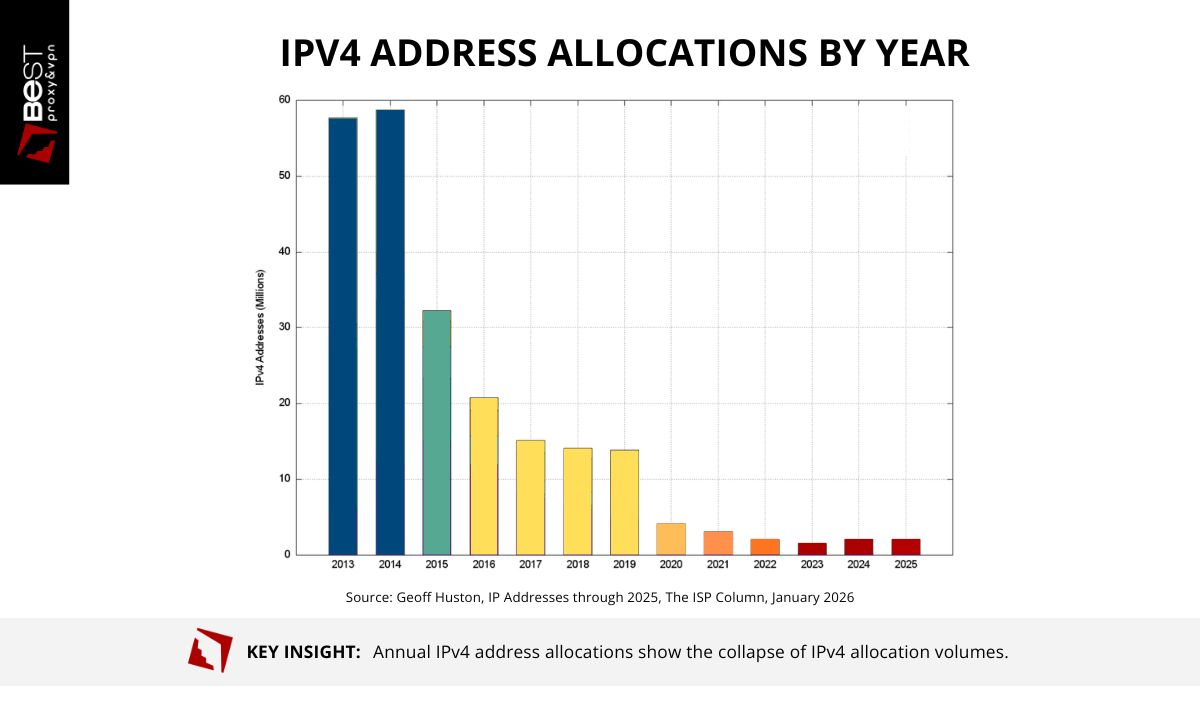
*Source: Geoff Huston, IP Addresses through 2025, The ISP Column, January 2026
Workarounds That Extended IPv4
Several mechanisms have delayed the practical impact of address exhaustion.
- Network Address Translation (NAT) allows multiple devices to share a single public IP address.
- Address reuse and reallocation enable organizations to transfer existing address blocks.
- Carrier-grade NAT (CGNAT) extends this model at the ISP level.
These approaches have allowed the internet to continue scaling without requiring a one-to-one mapping between devices and public IP addresses. However, these are compensations for a structural limitation, not a resolution.
Ongoing Impact
Because IPv4 addresses are limited but still widely required, they have become a constrained and, in some contexts, valuable resource. This constraint affects how networks are designed, how access is managed, and how IP-based systems operate. In environments where IP identity matters, shared addressing models are not always sufficient, which increases the demand for more controlled or dedicated IP allocation.
This limitation is one of the reasons why systems that rely on consistent or isolated IP identities, such as certain automation, data collection, or access-controlled environments, require more controlled IP allocation models.
IPv4 vs IPv6: What’s the Difference and Which Is Used Today?
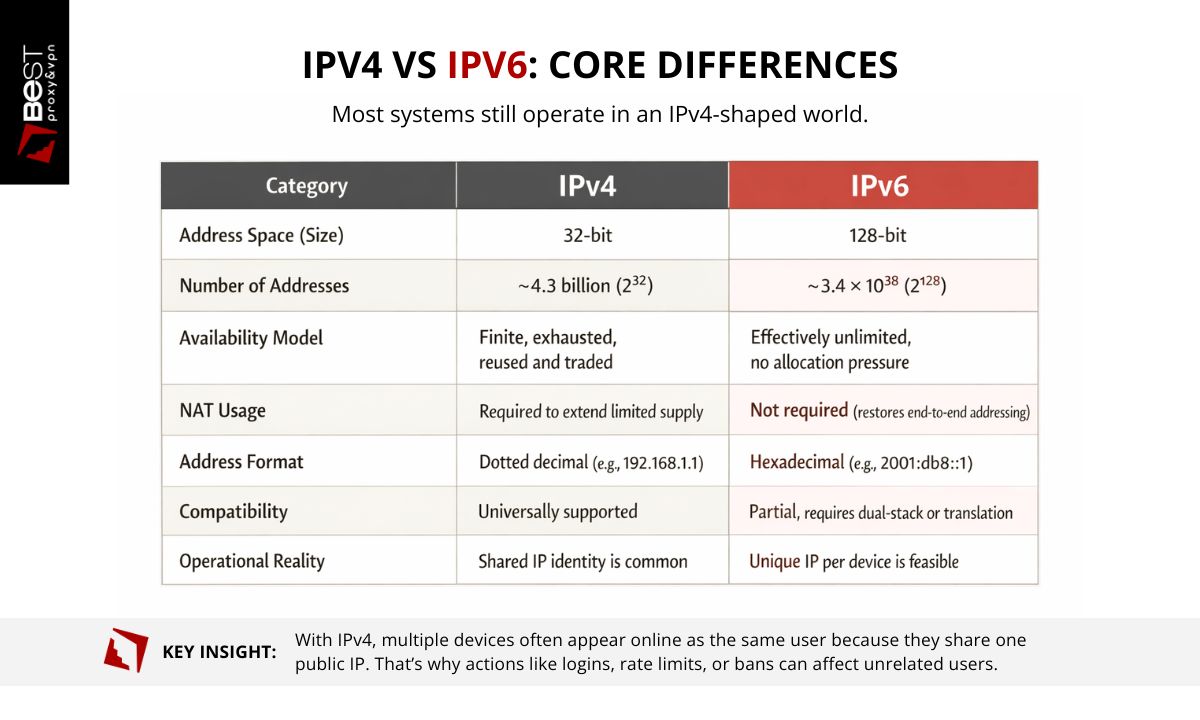
As the limitations of IPv4 became more apparent, a newer version of the Internet Protocol was developed: IPv6. While both protocols serve the same fundamental purpose, identifying devices and routing data across networks, they differ significantly in how they approach scale, compatibility, and network design.
Address Space
The most visible difference between IPv4 and IPv6 is the size of the address space.
- IPv4 uses a 32-bit address, allowing approximately 4.3 billion unique addresses
- IPv6 uses a 128-bit address, supporting an effectively unlimited number of unique addresses
IPv6 was designed to remove the constraints that led to IPv4 exhaustion, enabling long-term scalability as the number of connected devices continues to grow.
Address Format
The two protocols also differ in how addresses are represented.
- IPv4 addresses use dotted decimal notation (e.g., 192.168.1.1).
- IPv6 addresses use hexadecimal notation separated by colons (e.g., 2001:0db8:85a3::8a2e:0370:7334).
This difference reflects the larger structure of IPv6 addresses rather than a functional advantage in itself.
Network Design Differences
IPv6 introduces several architectural changes intended to simplify network configuration and improve efficiency:
- Larger address space eliminates the need for widespread NAT.
- Built-in support for automatic address configuration.
- More efficient routing and packet processing.
These changes make IPv6 more scalable and flexible from a design perspective.
Practical Adoption and Compatibility
Despite these advantages, IPv4 remains the dominant protocol across much of the internet. A large portion of existing infrastructure, services, and systems still rely on IPv4. As a result, many environments operate in dual-stack configurations, supporting both IPv4 and IPv6 simultaneously.
In practice, this means that compatibility, not just capability, determines which protocol is used. Systems that need to interact reliably with a wide range of services often continue to depend on IPv4.
How IPv4 and IPv6 Work Together
In cases where an IPv4-based system needs to interact with an IPv6-only service, direct communication is not possible without an intermediary layer. This requires translation mechanisms that can bridge the gap between the two protocols.
In practice, this is where solutions such as an IPv4-to-IPv6 converter proxy become relevant. These systems allow IPv4-based clients to access IPv6-only resources by handling the protocol translation at the network level, enabling compatibility without requiring changes to the underlying infrastructure.
IPv4 FAQ: Common Questions Answered
What is an IPv4 address?
An IPv4 address is a 32-bit numerical identifier used to locate a device within an IPv4 network and route data between systems. It defines both the source and destination of network traffic, allowing packets to be delivered across interconnected networks.
How many IPv4 addresses are there?
IPv4 supports approximately 4.3 billion unique addresses. However, not all of these are publicly usable, as some ranges are reserved for private networks, multicast, and special purposes.
Why are IPv4 addresses limited?
IPv4 addresses are limited because the protocol uses a 32-bit address space, which creates a finite number of possible combinations. As the number of internet-connected devices increased, the available pool of addresses was eventually exhausted.
Why are IPv4 addresses considered valuable?
IPv4 addresses are considered valuable because their supply is limited and they are still required by most internet services. This combination of scarcity and continued demand gives them practical and economic value.
Is IPv4 still used today?
IPv4 is still widely used and remains the dominant protocol across much of the internet. Many websites, platforms, and network systems rely on IPv4 for compatibility, even as IPv6 adoption continues to grow.
What is the difference between IPv4 and IPv6?
IPv4 uses a 32-bit address system, while IPv6 uses a 128-bit system that allows for a significantly larger number of unique addresses. In practice, IPv4 remains more widely supported, while IPv6 is designed for long-term scalability.
Can IPv4 communicate with IPv6 directly?
IPv4 cannot communicate directly with IPv6 because the two protocols are not compatible. Communication between them requires translation mechanisms or systems that support both protocols.
What is the difference between public and private IPv4 addresses?
A public IPv4 address is globally unique and accessible over the internet, while a private IPv4 address is used within a local network and cannot be reached directly from external systems. Private addresses are typically translated into a public address using Network Address Translation (NAT).
What is the difference between shared and dedicated IPv4 addresses?
A shared IPv4 address is used by multiple users or devices at the same time, typically through NAT or proxy systems. A dedicated IPv4 address is assigned to a single user or system, providing a consistent identity and greater control when interacting with external services.
Why do proxies use IPv4 instead of IPv6?
Proxies commonly use IPv4 because most websites and online services still rely on IPv4 for compatibility. IPv6 is not universally supported, which makes IPv4 more reliable for consistent access and interaction.
When is a dedicated IPv4 address necessary?
A dedicated IPv4 address is necessary when consistent identity, isolation, or reliability is required. It is commonly used in environments where shared IP usage can lead to restrictions, rate limits, or inconsistent access.
How does IPv4 scarcity affect real-world usage?
IPv4 scarcity leads to widespread sharing of IP addresses through mechanisms like NAT and proxy networks. This reduces individual control over how an IP address is perceived by external systems and can impact access, performance, and reliability.
Can IPv4-only systems access IPv6 services?
IPv4-only systems cannot access IPv6 services directly. They require a translation layer, such as a converter proxy or gateway, to enable communication between the two protocols.
IPv4 is no longer just a technical standard, it is a limited resource that still underpins most of the internet’s operational infrastructure. While IPv6 was designed to remove these limitations, real-world systems continue to depend heavily on IPv4 for compatibility and access. As a result, how IPv4 addresses are allocated, shared, and controlled has become increasingly important. In many environments, the difference is not the protocol itself, but the level of control over the IP address being used. This becomes even more relevant when evaluating how different proxy protocols handle IP-based communication and control.
In cases where consistent access, stability, or isolation is required, shared IP models are often not sufficient, which is why dedicated IPv4-based solutions are commonly used