

You bought the proxy thirty seconds ago. You paste the IP into a checker, or your anti-detect browser does it for you, and it comes back "high risk" or "burned". You message the provider, and the reply is that the fraud score "varies by database". Nothing has gone through that IP yet, so who scored it, and on what basis? This guide explains how proxy IP reputation is built, why checkers disagree, and what to do when the result is bad.
⏱ 15 min read Updated November 2026
Key takeaways
- Your proxy is scored before you use it — network type, abuse history, and subnet reputation are all evaluated at rest.
- The ASN is the first signal.
- Checkers disagree by design. Each vendor has its own data, formula, and scale — one result is one opinion.
- A score of 0 does not mean you're invisible. A hosting ASN with a clean score still gets detected.
- Residential is not a shield. It lowers the network-type risk; detection then shifts to behavior.
- Flags matter more than the number.
proxy=truewithoutrecent_abuseis different fromrecent_abuse=true. - Always check right before you use the IP — residential addresses churn fast, and scores change.
- If two or three checkers agree it's high risk, ask the provider for a replacement with evidence, not just a complaint.
What Is Proxy IP Reputation?
Proxy IP reputation is the risk rating that websites and fraud-detection vendors attach to an IP address, built from its network type, its history of abuse, and the behavior seen from it. Most express it as a score from 0 to 100; most tools call it a fraud score or an IP reputation score, and the terms are used interchangeably in the industry, but each vendor calculates its own.
That number is not a magic property of the IP. It is one layer in a larger system. "Is this a proxy?" is a detection question. "Has someone abused this IP?" is a history question. Vendors blend both, and sites then decide what to do with the result.
The Signals That Get Scored
Vendors do not publish their formulas, and most of what follows comes from companies that sell detection, so treat it as their description of the problem.
Network type and ASN
An ASN (autonomous system number) is the ID of the network that owns a block of IPs. A datacenter IP belongs to a hosting company, a residential IP to an internet provider, a mobile IP to a carrier. IPQS and Spur both say the ASN adjusts the score rather than acting as a yes/no rule. Even so, an IP announced by a hosting ASN starts with a label residential IPs do not carry.
Listings and past abuse
A blacklisted IP carries its record forward. Spam, credential stuffing, and known Tor, VPN, or open-proxy status all feed the score. If the previous holder left you a burned or dirty IP, you inherit the label until the databases update.
Your neighbors
Reputation can spread across a subnet (the block of adjacent addresses). Multiple IP intelligence sources describe scoring that takes the surrounding subnet and ASN into account, so a flagged neighborhood can drag down a clean address.
Behavior
A spotless IP can still be flagged by what is seen from it. Cloudflare says its residential proxy detection model uses behavioral and latency features, evaluated request by request. Detection moves from "who owns this IP" to "how does this client act".
Why Three Checkers Give Three Scores
Every vendor has its own data, its own weighting, and its own scale. BleepingComputer describes the same IP getting dramatically different scores from different services. When sellers answer Trustpilot complaints with "varies by database", that is accurate, if unsatisfying.
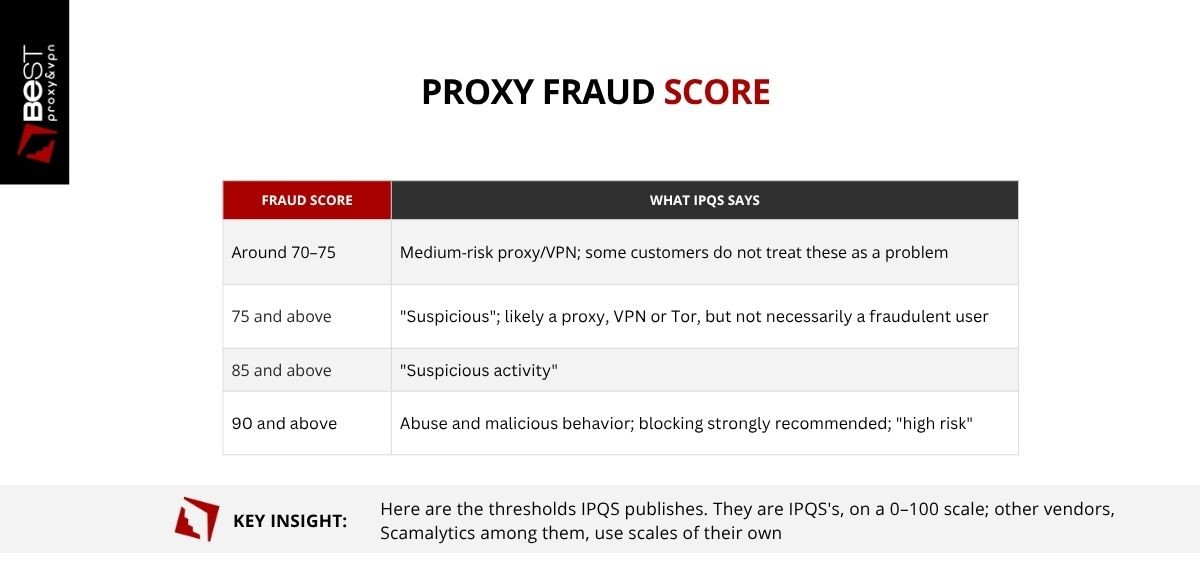
Here are the thresholds IPQS publishes. They are IPQS's, on a 0–100 scale; other vendors, Scamalytics among them, use scales of their own. IPQS recommends blocking at 90 and above. Their API documentation labels the bands across two pages, so each row names its source.
A 76 and a 92 are different situations even on one vendor, and a 76 on IPQS says nothing about what another tool would show.
Why Your Proxy Fraud Score Is High
The usual causes, roughly in the order worth checking:
- A hosting ASN. The IP belongs to a data center pool.
- Past abuse or a listing. A previous holder got it blacklisted.
- A flagged subnet. The neighbors are marked, and the score leans on them.
- A doubtful pool. In January 2026, Google announced that it disrupted much of the IPIDEA network: at least 13 brands, devices enrolled through SDKs, often without the owners' knowledge. How a pool was built shapes the reputation you inherit.
None of these require a single request from you. That is the answer to "why is my proxy flagged before I used it": the score describes the IP's past and surroundings.
Why a Score of 0 Doesn't Make You Invisible
The reverse also happens. IPLocation documents a datacenter IP with a fraud score of 0 that is still detected, because its ASN belongs to a hosting company. The fraud score is one factor, not the verdict.
Residential does not mean immune. A residential IP lowers risk on network signals, and detection then leans on behavior.
A score is a snapshot. Check right before you use the IP, not on the day you bought it. GreyNoise's report "The Invisible Army" found that 78% of residential IPs appeared in two sessions or fewer, and that home-network IPs were 39% of unique IPs but 22% of sessions — from a sample of roughly 4 billion sessions observed between 29 November 2025 and 27 February 2026. These come from attack traffic seen at the edge, not scraping, so do not stretch them to every proxy user. The practical lesson: residential addresses churn fast.
How to Check Proxy IP Reputation Before You Use It
These steps are for diagnosis. They help you decide whether to keep a proxy, not how to disguise one.
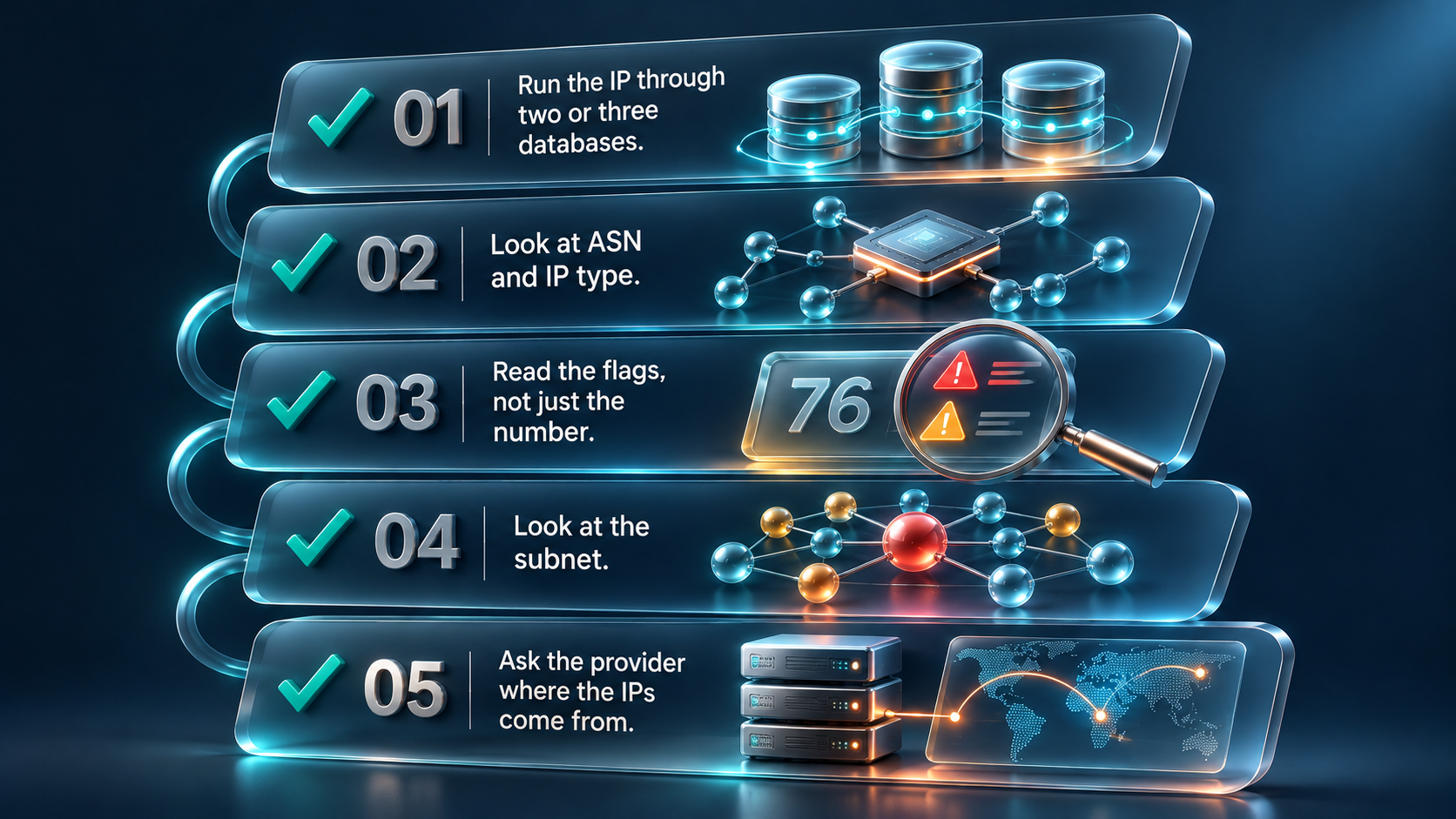
- Run the IP through two or three databases. For example, an IPQS lookup, Scamalytics, and an ASN lookup such as IPinfo. One result is one opinion.
- Look at ASN and IP type. Is it hosting, an ISP, or a mobile carrier? That is the category scorers start from.
- Read the flags, not just the number. In IPQS's Response Parameters,
proxy=truewith norecent_abusemeans the connection type was observed, not abuse. Ifrecent_abuseorbot_statusis true, the IP has history. - Look at the subnet. If neighboring addresses are flagged, treat your result with extra caution.
- Ask the provider where the IPs come from and what the replacement policy is.
Your Score Came Back Bad: What Now?
Use a simple rule. If two or three checkers agree the IP is high risk, or the ASN is hosting although you paid for residential, ask for a replacement.
Send evidence, not a complaint: a screenshot from each checker, the ASN, and the time of each check. Buyers on Trustpilot report sellers refusing replacements or going silent, so a dated paper trail is your leverage. If only one checker objects and the flags show proxy=true alone, you may be looking at one vendor's opinion.
No step here repairs a score. The point is to know what you have before you build a workflow on it.
Datacenter proxies are not the right tool for every job, and this page has not tried to pretend otherwise. What they are is consistent: the same IP, the same ASN, the same response time, every session. If your workflow depends on that — long-running tasks, accounts that need a stable address, monitoring that runs on a schedule — that consistency is the product. If you are still unsure whether static datacenter is the right fit, the 72-hour refund exists for exactly that reason.
FAQ
Why is my proxy flagged if I haven't used it yet?
Scoring starts from network type, past holders, and neighbors, not from your activity. A hosting ASN, a previous holder's abuse, or a flagged subnet can all produce a score before your first request.
Proxy fraud score is high: what does it mean?
One vendor's model rated the IP as riskier on its own scale. It is not a universal measurement. Check the same IP elsewhere and read the vendor's explanation of its bands.
Why do two checkers show different scores for the same IP?
Different data, weighting, and scales. Vendors do not publish their methodology, and no independent public data exists on how accurate any of them is.
Does a residential proxy always have a low fraud score?
No. Residential IPs reduce risk on network signals, but they can still be listed, inherit a bad neighborhood, or be flagged on behavior.
Why is my proxy blocked or hitting CAPTCHAs even with a low score?
Blocks come from behavior and network signals, not only from the score. See the section on why a score of 0 does not make you invisible.
The Score Is a Clue, Not a Verdict
A proxy IP reputation score is a diagnostic tool: a vendor's guess about network type, history, and behavior, compressed into one number. Use several signals, not one. One checker is an opinion. Three checkers plus the ASN is a diagnosis.
Sources
- IPQS: Proxy Detection API, Best Practices — ipqualityscore.com/documentation/proxy-detection-api/best-practices
- IPQS: Proxy Detection API, Response Parameters — ipqualityscore.com/documentation/proxy-detection-api/response-parameters
- IPQS: How IP Fraud Scores Work — ipqualityscore.com/articles/view/415/closer-look-ip-scores
- Spur: Why Context Beats Fraud Scores — spur.us/blog/ip-risk-scoring-vs-ip-context
- GreyNoise: The Invisible Army — https://www.greynoise.io/resources/invisible-army-residential-proxy-abuse-report
- Cloudflare: Residential proxy bot detection using machine learning
- Google disrupts IPIDEA
- IPLocation: How websites detect proxies despite a 0 fraud score — https://www.iplocation.net/blog/how-websites-really-detect-proxies-despite-the-ip-having-a-0-fraud-score
- BleepingComputer: Inside the search for clean residential proxies for carding — https://bleepingcomputer.com/news/security/inside-the-search-for-clean-residential-proxies-for-carding
- TrustMyIP: Proxy fraud score — trustmyip.com/blog/proxy-fraud-score
- Peakhour: Proxy score and fraud score — peakhour.io/learning/residential-proxies/proxy-score-and-fraud-score
- Trustpilot: Proxy-Cheap reviews
- Trustpilot: Floxy reviews